
Short answer: getting a bow hunting license comes down to five steps — check your state wildlife agency, complete hunter education if it's required for you, buy the base hunting license, add the species tags or archery permits your state requires, and confirm the current season dates and equipment rules before you go. Requirements vary by state, by residency and by species, and most of the process can usually be done online in minutes.
Bowhunting is an exciting and challenging sport that requires skill, patience and knowledge. However, before you can start your hunting adventure, you need to acquire a bowhunting license.
Like any other hunting license, a bowhunting license is required by law in most states and countries. It ensures hunters have the knowledge and skills to hunt safely, ethically and responsibly. In this blog post, we will walk you through the process of getting a bowhunting license, including requirements, fees, and steps.
From understanding the rules to passing the exam, we cover everything you need to know to become a licensed bowhunter. So grab your bow and arrow and let's get started!
📋 Key Takeaways
- Bowhunting licensing is state-specific — your state wildlife agency's current rules are the final authority.
- Hunter education is required for first-time hunters in every state, with age thresholds and exemptions that vary.
- A hunting license and species tags are separate in most states — check both before opening day.
- Resident licenses are typically much cheaper than nonresident licenses; residency proof rules vary.
- Some states add an archery permit or bowhunter education requirement for bow seasons — not all do.
- Most states sell licenses online, and many offer apprentice/mentored programs for beginners.
📑 Table of ContentsJump to any section in this guide 11 sectionsView contentsHide contents
- Do You Really Need a Bow Hunting License?
- Steps To Get A Bow Hunting License
- License vs Tag vs Permit — What's the Difference?
- Resident vs Nonresident
- Hunter Education: Online vs In-Person
- State Requirements: What to Expect
- Equipment Rules: Draw Weight & Crossbows
- Apprentice & Youth Programs
- Step-by-Step Timeline for Beginners
- What You May Need Before Applying
- Frequently Asked Questions
Do You Really Need a Bow Hunting License?
The first step to bow hunting in any state is obtaining a hunting license, which is required by law in every state. This license not only allows you to gain knowledge and skills but also ensures that you know and follow local hunting rules and regulations.
Additionally, a hunting license certifies that you have received the necessary training and have the proper equipment to hunt safely and responsibly.
In addition, bowhunting licenses help state agencies control the number of hunters in a given area and manage wildlife populations more effectively. The funds obtained from the purchase of these permits play a vital role in the protection and preservation of natural resources for future generations of hunters.
Essentially, obtaining a bowhunting license is not only a legal requirement but also a way to contribute to the conservation of local wildlife.
Steps To Get A Bow Hunting License
The steps required to obtain a bow hunting license may differ depending on the state of residence. Variations in the process and associated costs are to be expected. However, as a general guideline, the following steps should be followed:
1. Pass A Hunter Education Course
In many states, individuals interested in hunting are required to successfully complete a hunter education course. These courses are designed to educate students on the hunting laws specific to their state and encourage responsible and safe hunting practices.
They cover critical safety measures and other fundamental aspects of hunting that can enhance one's proficiency in the field. Depending on the state of residence and the age of the individual, passing a hunter education course is mandatory for obtaining any type of hunting license.
2. Check Out Your State's Wildlife Website
Each state has its own government agency that oversees its wildlife and outdoor resources. To familiarize yourself with the state's wildlife regulations, it is best to visit the state agency's website. In addition to providing information on local hunting laws, these websites offer other useful resources.
You can learn about the process for enrolling in hunter education courses, purchasing hunting licenses or tags, and accessing other essential information. Some state wildlife websites even offer online hunter education courses or the ability to purchase licenses and tags directly from the website.
3. Consider Reviewing The Available Licensing Options
After locating the appropriate website for your local wildlife agency, you can explore the available bow hunting licenses. It is important to note that licensing requirements and options vary by state, so you may need to conduct some research to determine the correct license and application process.
Carefully examine all available licensing options, which may include different date ranges or licenses specific to particular seasons or weapons, such as archery. For instance, one type of hunting license may be valid for only a week, while another version of the same license may be valid for an entire year but come with a higher cost.
4. Make The Necessary Payment For Your License
Once you have evaluated all available licensing options, the next step is to obtain your bow hunting license. In many cases, the process is straightforward and can be completed online via the agency's website.
Once you have successfully purchased the license, you can either print a copy to carry with you or have a physical license mailed to your address. In some states, it may still be necessary to purchase the license in person, but this is becoming less prevalent due to the convenience and accessibility of online purchasing.
Most states now also offer digital licenses through official agency apps and portals — an electronic copy on your phone is usually valid proof in the field, but check your state's rules on carrying it.
License vs Tag vs Permit — What's the Difference?
These terms trip up new hunters, and the terminology varies by state. As a general guide:
- Hunting license — the general authorization to hunt, subject to the state's rules. Everyone who hunts needs one.
- Tag — usually tied to harvesting a specific animal, like a deer, elk or turkey tag. Tags are often limited, and some states issue them through a lottery or draw.
- Permit or endorsement — an add-on that can grant permission for a specific season, area, method or species, such as an archery endorsement in states that use one.
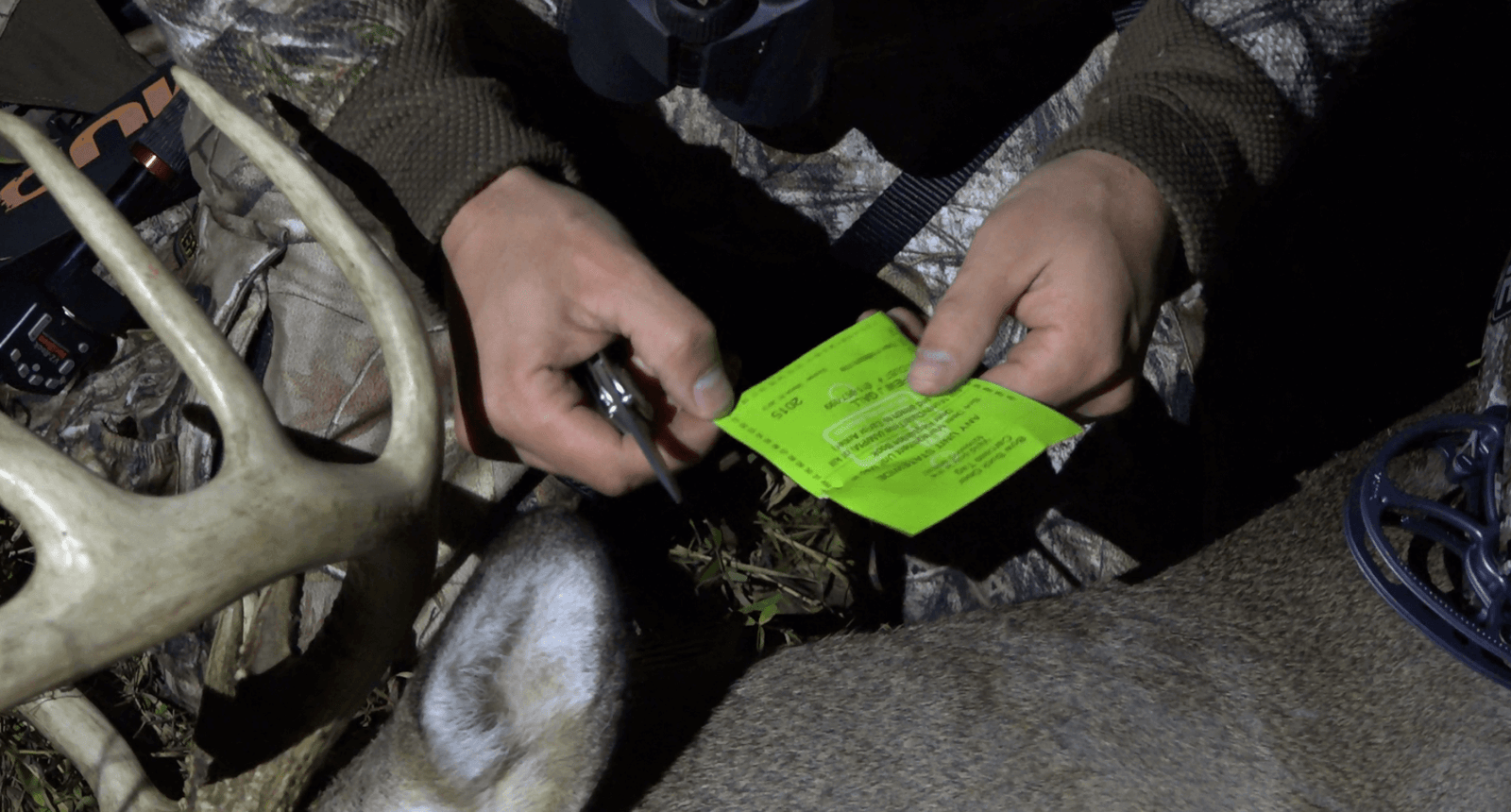
A tag is essentially a ticket that allows a hunter to go after a certain species of animal. These tags are primarily used on larger game such as elk, moose, deer, bear, and sheep — though they may also be necessary for small game in some situations. When you buy a hunting license, it usually comes with a tag for a specific species; if not, you purchase tags separately.
In areas where there are more hunters than available animals, tagging is often limited and a lottery is used to determine who gets the tag.
Resident vs Nonresident
Two things change dramatically when you hunt outside your home state: price and availability.
- Fees differ — resident licenses typically cost roughly $20–$75; nonresident licenses commonly run $100–$500 or more depending on the state and species.
- Residency definitions are state-specific — how long you must live in a state (and what proof is accepted) varies, so read the fine print before buying a resident license.
- Limited tags may have separate quotas — several states reserve a portion of draw tags for nonresidents, which can mean different odds or deadlines.
For more on hunting away from home, see our bow hunting guide.
Hunter Education: Online vs In-Person
Hunter education certification is required for first-time hunters in every state, though the exact age thresholds and exemptions vary — some states, for example, exempt hunters born before a certain date. Most states offer three formats:
- Traditional in-person classroom — instructor-led, often one or two sessions, good for hands-on questions and first-time hunters.
- Online + field day (hybrid) — the coursework is completed online, then a shorter practical field session is completed in person. This is the most common format today.
- Online-only — a growing number of states offer fully online courses, usually for adult hunters or renewals.
Certifications are generally reciprocal: most states accept a hunter education card issued by another state. A separate bowhunter education course is required in a number of states (roughly a dozen) for bowhunters — New York, Connecticut and New Jersey are long-standing examples. Your state agency's website lists exactly what applies to you.
State Requirements: What to Expect
Every state publishes its license structure, fees and season dates on its official wildlife agency website. Rather than a 50-state fee table (fees change every year), here is how a cross-section of states structures their bowhunting requirements — check the official site for current fees and dates:
| State | Hunter education | Archery add-on | Apprentice / mentored option | Official source |
|---|---|---|---|---|
| Texas | Required if born after Sep 1, 1971 | Archery endorsement | Yes — mentored from age 9 | tpwd.texas.gov |
| Pennsylvania | Required for all first-time hunters | Archery license required for bow seasons | Yes — mentored youth/adults | pgc.pa.gov |
| Michigan | Required if born after Jan 1, 1960 | Base license covers bow; bowhunter ed recommended | Yes — apprentice program | michigan.gov/dnr |
| New York | Required for all first-time hunters | Bowhunting privilege + bowhunter ed required | Yes — mentored youth program | dec.ny.gov |
| California | Required for all first-time hunters | Archery tag/endorsement for archery seasons | Yes — apprentice program | wildlife.ca.gov |
| Ohio | Required for all first-time hunters | Either-sex deer permit with archery season | Yes — apprentice license | ohiodnr.gov |
| Colorado | Required if born after Jan 1, 1949 | Archery license required for archery seasons | Yes — mentored hunts | cpw.state.co.us |
| Florida | Required if born after Jun 1, 1975 | Archery season permit | Yes — mentored program | myfwc.com |
The same pattern repeats nationwide: a base hunting license, species tags or permits, and in some states an archery-specific add-on. Confirm the current structure, fees and season dates on your state's official site — regulations and fees change annually.
Equipment Rules: Draw Weight & Crossbows
Two equipment rules come up most often:
- Minimum draw weight — most states set a minimum draw weight for bowhunting big game, commonly around 30–40 pounds for deer. A handful of states have no minimum at all. Confirm your state's current number before buying or hunting with a light bow.
- Crossbows — most states now allow crossbows during all or part of the archery season, but the details vary widely: some treat them like vertical bows, some restrict them to firearm seasons, and some require an age or disability qualification. A few states still limit crossbow use in archery season. Check the current rule for your state and season.
Other common rules include minimum arrow weights, broadhead requirements and Sunday hunting restrictions in certain states — all published on your state agency's website.
Apprentice & Youth Programs
Most states offer apprentice or mentored hunting licenses — a reduced-fee, short-term license that lets a new hunter try hunting alongside a licensed mentor before completing hunter education. Age rules and supervision requirements vary by state, and these programs are among the cheapest ways to experience a first season.
Youth seasons and family programs are also common, and many states run mentored youth hunts with lower fees. If you are introducing a young hunter, start with your state's apprentice option.
Sunday Hunting Laws
Some states prohibit or restrict hunting on Sundays, while others allow it broadly — the rules can even differ by county or by species. Confirm your state's Sunday rules for the season you plan to hunt.
Penalties & Fines for Hunting Without a License
Hunting without the required license is illegal in every state, and the consequences can be serious: fines, loss of hunting privileges, confiscation of equipment, and in some cases criminal charges. Penalty amounts and severity vary by state and by the specific violation — another reason to verify your paperwork before opening day.
Lifetime & Multi-Year License Options
Many states offer multi-year or lifetime hunting licenses, which can save money for hunters who plan to hunt for many seasons — and several states offer them at reduced cost for seniors and youth. Whether the upfront price makes sense depends on how often you'll actually hunt, so compare it against annual fees for your state.
Step-by-Step Timeline for Beginners
- 3–6 months before the season — complete hunter education (and bowhunter education if your state requires it).
- Before draw deadlines — if your state runs lotteries for deer/elk tags, note the application deadlines — they can be months before the season.
- Weeks before opening day — buy your base license, tags and any archery permit; print or download your license.
- Opening week — confirm season dates, equipment rules and carry requirements; practice and check your gear.
What You May Need Before Applying
Most states let you buy licenses online in minutes. Have the following handy (requirements vary):
- Government-issued identification and your date of birth
- Hunter education certificate number, if applicable to you
- Proof of residency, if applying for a resident license
- A payment method — most portals accept credit/debit cards
- Your choice of species and season, plus your previous license or customer ID if you have one
One practical note: this article is an educational overview, not legal advice. Regulations change every year — always confirm current requirements, fees and season dates directly with your state wildlife agency before hunting.
Frequently Asked Questions
Yes. Every state requires a hunting license to hunt big game, and bowhunters generally need the same base hunting license as other hunters, plus any species tag or archery permit the state requires. Requirements vary by state, age and species — check your state wildlife agency.
Some states do. A number of states issue archery-specific permits or endorsements (often a small add-on fee or stamp) for bow seasons, and about a dozen states also require a separate bowhunter education course for bowhunters. Other states only require the base hunting license plus a species tag. Check your state's current rules.
Hunter education is required for first-time hunters in every state, though age thresholds and exemptions vary — some states exempt older hunters born before a certain date. Courses are offered in-person, online and as hybrids, and most states accept hunter education certification from other states.
Yes — every state sells nonresident hunting licenses, typically at a higher price than resident licenses. Nonresidents may face separate draw odds for limited tags, and proof of residency rules for the cheaper resident licenses vary by state.
A hunting license is the general authorization to hunt, subject to state rules. A tag is usually tied to harvesting a specific animal or species — for example a deer or elk tag. Terminology varies by state, and permits or endorsements may add permission for a season, area or method. Check how your state uses these terms.
Always start with your state wildlife agency's official website — every state publishes current license types, fees, seasons and regulations there. Rules and fees change annually, so confirm requirements for the current season directly with the agency before hunting.